

A tuition company in Singapore just ran one of the smartest social ads I’ve seen this year.
It may also be one of the riskiest brand decisions.
Their Instagram carousel opens with:
“Teng. You still haven’t paid us.”
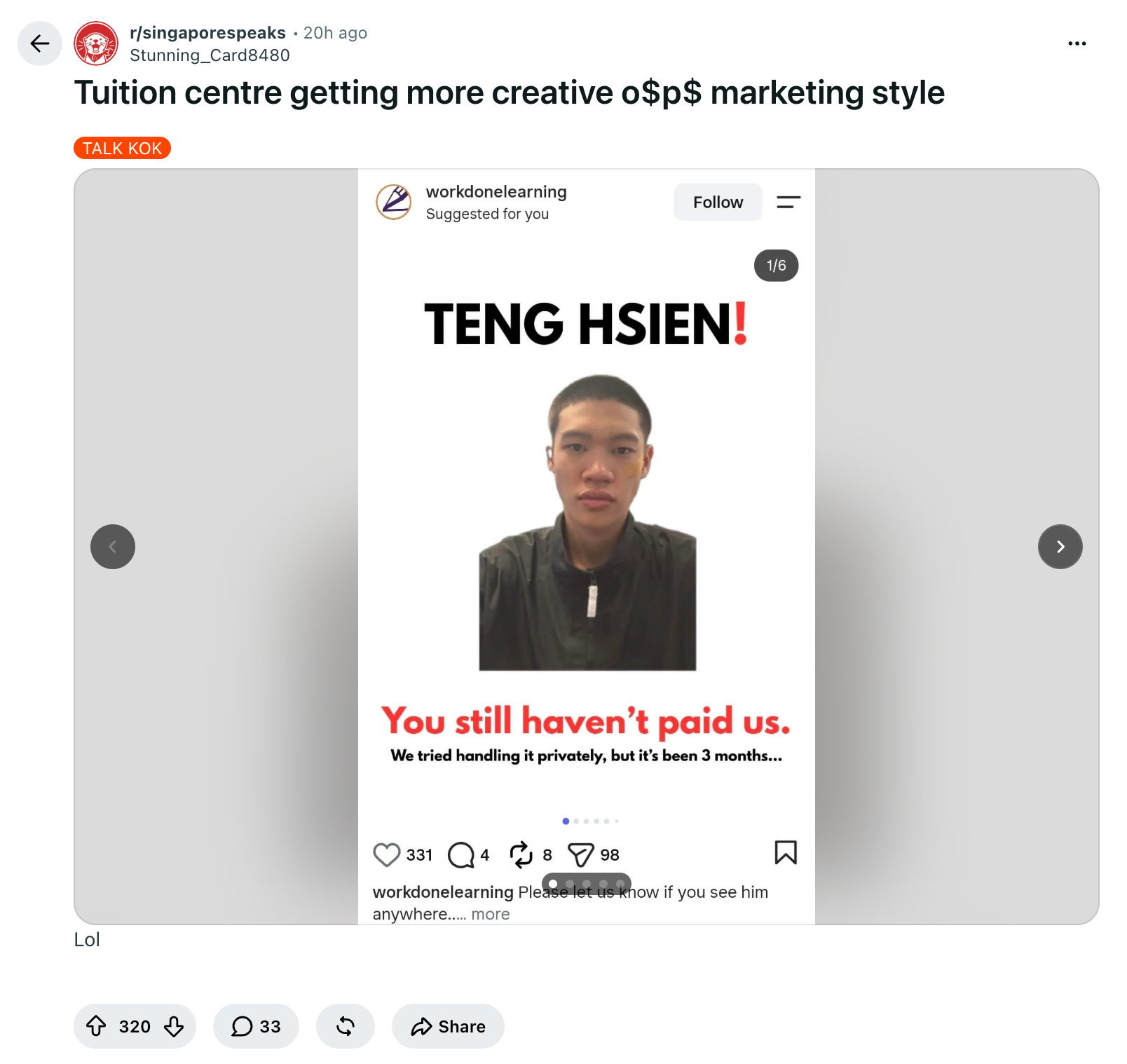
His photo is front and centre.
“Please let us know if you see him anywhere.”
Your immediate reaction is obvious:
What happened?
So you swipe.
Slide 2: his A-Level improvement.
Slide 3: his final result.
Slide 4: the study materials.
Slide 5: WhatsApp messages at 3am.
Slide 6: "Okay. We lied".
Teng doesn’t owe them anything.
The entire debt-collection story was a setup to demonstrate how far the company went to help a student succeed.
And as attention creative, it is exceptionally good.
The first slide creates a huge pattern interrupt.
The accusation opens an information gap.
The carousel becomes the mechanism for resolving it.
But the smartest part is what happens next.
Proof isn’t appended to the creative. Proof becomes the creative.
They don’t say:
“We care deeply about our students.”
They show a student messaging them at 3am.
They don’t claim:
“We deliver great results.”
They show the improvement curve.
They don’t describe the service.
They let you experience what the service feels like through the story.
That is excellent creative strategy.
But there is a second question that matters just as much:
What does this do to the brand?
Not everyone who sees slide 1 will reach slide 6.
Some people will scroll away.
Some may encounter a screenshot without the reveal.
Some may remember only the accusation.
And the associations created in those few seconds could be:
Debt.
Public shaming.
Conflict.
A student refusing to pay.
None of those are associations the company actually wants to own.
That exposes an important distinction marketers sometimes overlook:
Getting remembered is not the same as building a brand.
The real question isn’t:
“Will people remember this ad?”
It is:
“What will people remember about the brand because of this ad?”
That question changes how I evaluate the campaign.
The strongest idea here is actually much more powerful than the stunt itself:
We go ridiculously far to help our students succeed.
That is a brand position worth owning.
It communicates commitment.
It differentiates the experience.
And it gives the company a creative territory it could return to repeatedly.
The provocative storytelling mechanism could stay, while reducing the reputational risk.
For example:
“Teng, we need to talk.”
Or:
“Why did we spend months chasing Teng?”
You still create curiosity.
But now the tension points toward the eventual brand message instead of temporarily creating an unrelated negative association.
Take that idea further and it could become a repeatable creative platform.
Different students.
Different unexpected openings.
Different evidence.
Same underlying promise:
Look how far we’ll go to help you succeed.
At that point, a one-off viral stunt starts becoming something much more valuable.
A recognizable brand asset.
And that leads to the broader lesson.

Social creative can do three different jobs:
Virality earns attention.
Performance turns attention into action.
Branding turns attention into memory and meaning.
They are related, but they are not the same.
A campaign can generate huge engagement without creating useful brand memory.
It can generate conversions without building long-term differentiation.
And it can build awareness without giving people a reason to act.
The hardest creative work does all three:
Stop me.
Move me.
Make me remember something meaningful about you.
That is the standard I’d use to judge this campaign.
Brilliant attention strategy?
Absolutely.
Brilliant branding?
Almost. And that "almost" is what makes it such an interesting case study.