

Here is a sequence that runs often enough to count as a genre.
An AI company decides to enter Southeast Asia. It starts in Singapore, because Singapore is where the regional offices sit and where the English-language pitch lands. Six months later there is a customer, maybe two, both regional headquarters. Checkout works. Sales runs on LinkedIn and email. Procurement is demanding but legible. The security review is hard in familiar ways.
The company concludes it has entered Southeast Asia.
It has entered a market of 6.1m people with GDP per person of US$107,758, and it has learned almost nothing transferable about the 611m people next door.
Singapore is not a beachhead. It is the one market in the region where a standard Western GTM motion works end to end, which is precisely what makes it useless as a proxy. Every assumption that survives Singapore is an assumption that has not been tested.
There are four of them.
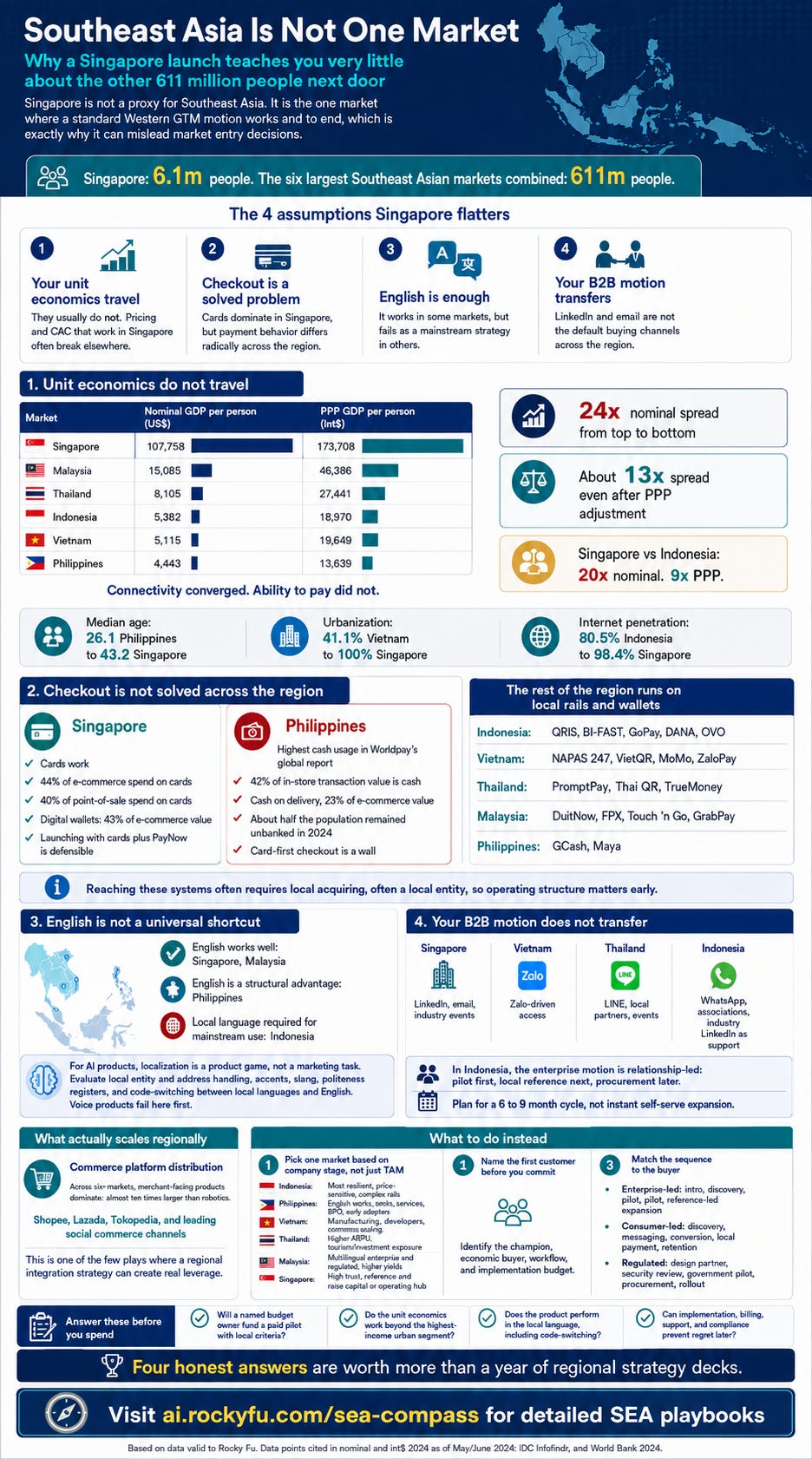
Your unit economics travel
Nominal GDP per person across the six largest Southeast Asian markets, 2026 IMF estimates:
Market Nominal PPP:
Singapore US$107,758 Int$173,708
Malaysia US$15,085 Int$46,986
Thailand US$8,105 Int$27,441
Indonesia US$5,362 Int$18,970
Vietnam US$5,115 Int$19,649
Philippines US$4,443 Int$13,639
A 24x spread from top to bottom.
Purchasing-power adjusted it compresses to about 13x, which is still not a range any single pricing tier survives. Singapore against Indonesia alone is 20x nominal and 9x PPP.
The failure mode is specific and it is not “the market is too poor.” It is that paid acquisition is priced against global advertiser demand while your revenue per user is priced against local income. The two numbers decouple at the border.
A product that clears CAC comfortably in Singapore can clear it nowhere else in the region at the same price, the same channel mix, and the same self-serve motion.
The structural variables move just as far. Median age runs from 26.1 in the Philippines to 43.2 in Singapore. Urbanization runs from 41.1% in Vietnam to 100% in Singapore. Internet penetration is the one metric that nearly converges, 80.5% in Indonesia to 98.4% in Singapore, and it is also the one founders most often use to justify treating the region as one thing.
Connectivity converged. Ability to pay did not.
Checkout is a solved problem
This is the assumption Singapore flatters most, and I want to be precise about it because the sloppy version of this argument is everywhere.
In Singapore, cards work. Singapore has the highest credit-card penetration in Southeast Asia, and cards took roughly 44% of e-commerce spend and 40% of point-of-sale spend in 2025.
Digital wallets are now marginally larger at 40% of e-commerce value, but a substantial share of that is tokenised cards sitting inside Apple Pay, Google Pay and card-linked wallets, so a card processor still captures it. If Singapore is your first market, launching on cards and adding PayNow is a defensible plan.
Then look at the Philippines. It records the highest cash usage in Worldpay’s entire global report: 42% of in-store transaction value. Cash on delivery is still 23% of e-commerce value. Roughly half the population remained unbanked as of the World Bank’s 2024 data. Card-first checkout there is not suboptimal, it is a wall.
Indonesia, Vietnam, Thailand and Malaysia sit between those poles, and all four run on wallets layered over national real-time rails: QRIS and BI-FAST, NAPAS 247 and VietQR, PromptPay and Thai QR, DuitNow and FPX.
The consumer interfaces are GoPay, DANA and OVO. MoMo and ZaloPay. TrueMoney. Touch ‘n Go and GrabPay. GCash and Maya in the Philippines.
These are national infrastructure, not payment processors. Reaching them generally requires a local acquiring relationship, which generally requires a local entity, which means the corporate-structure question arrives in week one rather than month six.
The honest statement of this assumption: it holds in a market of 6.1m people and degrades across the other 611m, fastest in the market with the youngest population.
Note: Worldpay’s Global Payments Report puts Singapore cards at 44% of e-commerce spend; 2C2P’s IDC infobrief puts card payments at around 73% of Singapore e-commerce transactions. My experience tends to agree with the latter.
English is enough
In Singapore and Malaysia, English is enough. In the Philippines, English access is a genuine structural advantage and one of the main reasons to enter at all.
In Indonesia, it is not. Bahasa Indonesia is required for mainstream use, for support, and for most local selling. English works with multinationals and regional technology teams, which is to say it works with the subset of buyers who look most like the Singapore customer you already have.
For AI products this is a model evaluation problem before it is a marketing problem, and it is the section of this argument I would most want a technical founder to read twice.
The things that actually break in production are local entity and address handling, regional speech and accents, slang, politeness registers, and code-switching between the local language and English inside a single sentence.
That last one is the killer, because almost nobody benchmarks it. A model can score well on translated evaluation sets and still fail on how people actually talk. Voice products fail here first and hardest.
Run that evaluation before you commit GTM budget. It is a product gate, not a localisation ticket. Discovering it after you have hired a country lead is the expensive ordering.
Your B2B motion transfers
In Singapore, B2B trust runs through LinkedIn, email, and industry events. That is a motion your existing sales team already knows how to run.
It is not the motion elsewhere. In Vietnam, B2B access runs substantially through Zalo. In Thailand, through LINE, local partners and events. In Indonesia, through WhatsApp, industry associations, and LinkedIn as a supporting channel rather than the primary one.
This is not a tooling detail. It determines whether your outbound sequence is a sequence at all, whether your CRM captures anything real, and whether the person who can actually sponsor a deal is reachable by someone who has never met them.
In Indonesia specifically, the enterprise motion is relationship-led: pilots, integration readiness, and a local reference typically precede scaled procurement. The reference is the risk control.
Which means your first revenue there is a scoped paid pilot with a named executive sponsor and defined conversion terms, not a self-serve account that expands. Your pipeline model needs a six-to-nine-month cycle in it, and your comp plan needs to survive that.
I would not extend that claim to every market in the region without checking each one. I would extend the general principle: the Singapore motion is the outlier, not the template.
What doesn’t change
One thing is genuinely regional, and it is worth knowing which one.
Commerce distribution is the same everywhere: Shopee, TikTok Shop, Lazada, plus Tokopedia in Indonesia. Six markets, one shortlist. If your product touches merchants, sellers, creators or checkout, this is the single place you get real regional leverage: one integration strategy, roughly one merchant motion, from Jakarta to Singapore.
The trade is that your distribution partner is effectively chosen for you, and your take rate, policy exposure and roadmap dependencies sit with a very small number of platforms. That is worth pricing deliberately rather than discovering in year two.
So what do you actually do
Three decisions, in order.
Pick one market on company shape, not on TAM. Mass-market and price-sensitive workflows point to Indonesia. Voice, services, workforce and learning point to the Philippines.
Manufacturing, developer and commerce operations point to Vietnam.
Retail, hospitality, healthcare and industrial workflows point to Thailand.
Multilingual enterprise products and regional testing point to Malaysia.
Regulated enterprise, regional headquarters and reference value point to Singapore.
Treat that as a shortlist to test, not a ranking to obey.
Name the first customer before you commit resources.
Not a segment. A specific business unit with a high-volume workflow, an accountable owner, and budget for implementation. If you cannot name the champion, the economic buyer, and the gates between them, you do not have a market-entry plan, you have a travel itinerary.
Pick the sequence that matches the buyer.
Enterprise-led: target account, trusted introduction, discovery, paid pilot, reference-led expansion. Consumer-led: discovery, messaging, conversion, local payment, retention. Regulated: design partner, security and data review, governed pilot, procurement, rollout.
Then answer the questions that can kill the plan before you spend against it.
Will a named budget owner fund a paid pilot with defined rollout criteria?
Do the unit economics work beyond the highest-income urban segment?
Does the product perform natively in the local language, including local speech and code-switching?
Can implementation, billing, support and compliance be delivered without eroding the target margin?
Four honest answers there are worth more than a year of regional strategy decks.
I put the full comparison into a free briefing called SEA Compass for GTM development:
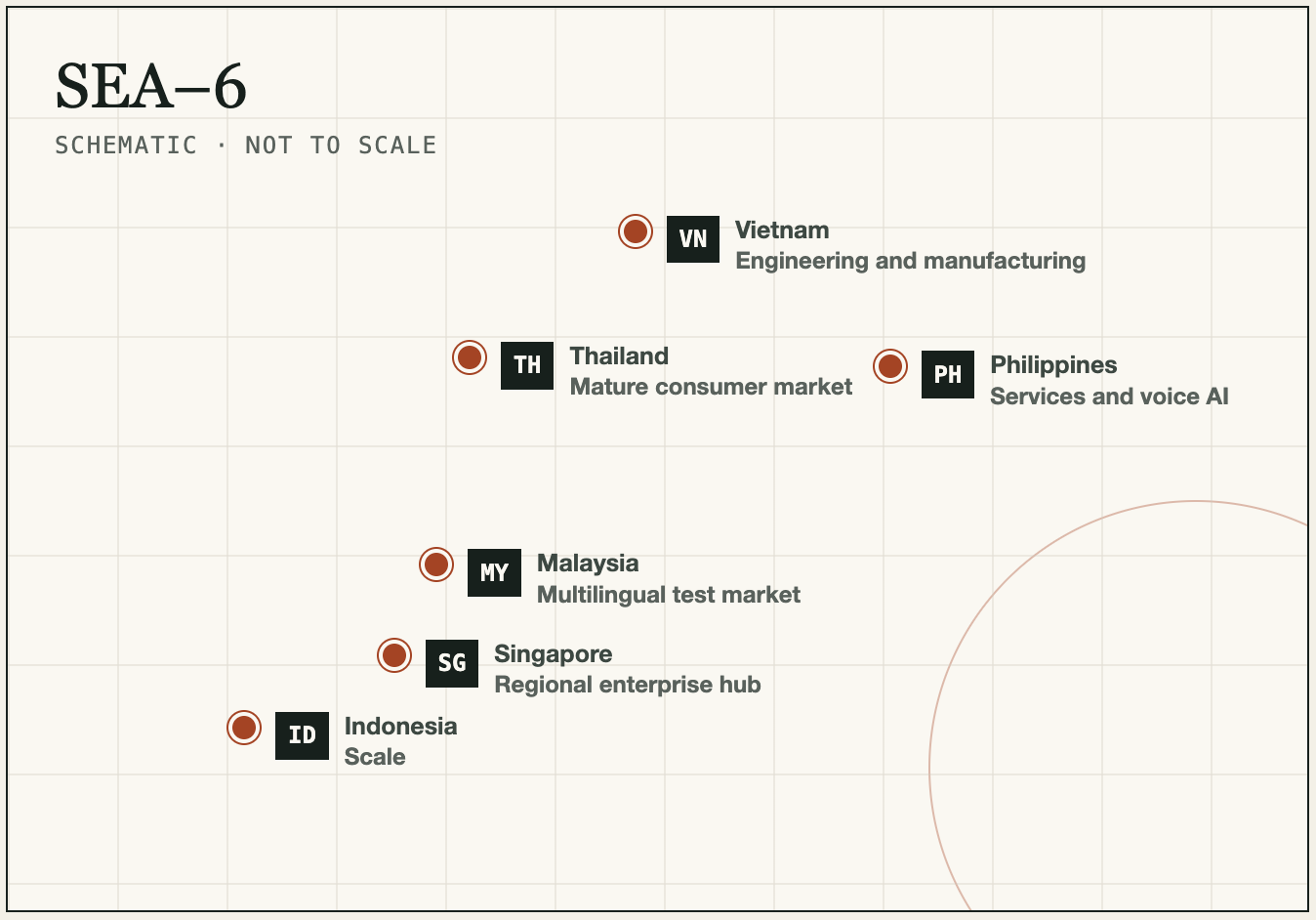
six markets side by side on scale, digital demand, buyers and channels, plus a country playbook for each covering localisation, operating setup, sales motion, regulatory watchouts, a first-90-days sequence and the go/no-go questions.
Every figure carries its source, period and caveat. The judgement calls are labelled as judgement calls.
Read it here → https://ai.rockyfu.com/sea-compass
If you are running a market-selection decision right now, reply and tell me which two markets you are weighing and what is blocking the call.