

A wrong positioning decision can spread quickly through an AI workflow. Before anyone catches it, the same mistake appears in the brochure, launch email and sales deck.
Over the past year, I’ve been building marketing AI workflows with deliberate checks before decisions spread into downstream work. Positioning and messaging is a useful example because one choice shapes so many assets.
These are five rules I use to make the output easier to verify and reduce the work of correcting it.
The five rules:
Make the reasoning behind the message inspectable
Put the human decision where it prevents downstream rework
Tell AI what a usable result looks like
Preserve decisions when the work changes hands
Measure correction cost, then earn the right to add complexity
Positioning and messaging is the example throughout because it’s high-leverage, one direction choice that shapes every downstream asset. The workflow logic transfers to other job functions.
Make the reasoning behind the message inspectable
In product marketing, a capability and a customer outcome require different kinds of evidence.
Take an AI image-editing product. A specification might confirm that it can change a product photo’s background. That supports a capability statement. A claim that it halves a retailer’s production costs needs evidence about the retailer’s production process and results.
A polished paragraph can make the distance between those claims surprisingly easy to miss.
This is why I build source references and fact-versus-inference labels into the messaging workflow.
Every proposed claim includes a source reference and an evidence status: directly supported, inferred, or unsupported. Reviewers can check both the original material and whether it justifies the wording.
An AI confidence label is an invitation to check, not evidence that a claim is true. An explicit evidence gap is more useful than an unsupported promise that quietly enters a marketing brochure.
For your next task, give AI a short source map; this is a simplified illustration:
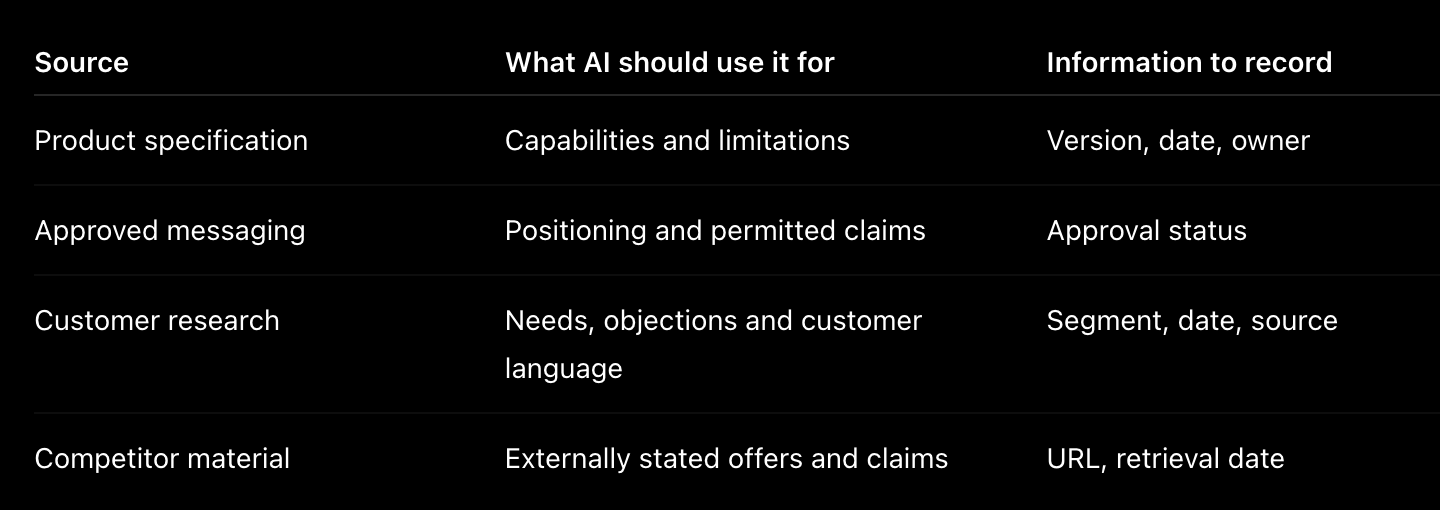
You should create a file (or ask AI to create it for you) to identify the current specification, approved messaging, and usable customer evidence. And, do include versions or dates and explain which source takes priority when documents disagree. Make sure AI can access them.
Then ask AI to flag proposed benefits that the sources do not yet establish. That gives you something concrete to resolve with a colleague.
I also record whether material is approved for external use, internal-only, or awaiting clearance. Before publication, a separate check flags restricted material and unresolved claims for human review.
Put the human decision where it prevents downstream rework
The pause before choosing AI-generated positioning matters because that choice affects everything that follows.
Consider two possible directions for an AI creative product: helping a team produce more variants, or helping it maintain visual consistency. They may draw on the same underlying capabilities. They lead to different headlines, demonstrations and sales conversations.
In my workflow, AI generates two to three positioning options for human evaluation. Once a direction is selected, AI drafts the messaging framework from a predefined template.
A separate AI agent then checks the draft against a compliance and consistency checklist before cross-functional review. It checks the draft against documented rules. Its involvement does not independently establish accuracy or compliance.
When an approved positioning decision or product claim changes, my workflow flags the affected assets for review. Their owners determine which need updating.
My rule is to put review at the point where a wrong decision would multiply work. That does not mean asking someone to approve every sentence. It means being clear about who chooses the audience, accepts the central promise, and confirms the product claims.
Tell AI what a usable result looks like
"Make it more compelling" is reasonable feedback between humans. But, it gives AI almost nothing to act on.
For a messaging framework, I want to know whether the audience is specific, whether the value follows from the capabilities, and whether the differentiation survives comparison with the alternatives. The writing needs to make those choices understandable.
For a launch email, the brief can be much simpler:
Write for existing e-commerce customers. Introduce the approved background-editing capability and invite them to request a demo. Keep the email under 200 words. Use only supported product claims. List any missing evidence separately.
That brief supplies a practical review standard. If the email introduces an unapproved feature, it fails even if the opening is excellent.
Without a standard, revision can become an exchange of adjectives: “sharper,” “punchier,” “more strategic.” Eventually, the adjectives need a project manager.
There is a boundary worth naming: high-quality AI output is not the same as market effectiveness.
Internal approval means we are prepared to use the message. Whether customers understand it, believe it, and act on it requires audience feedback and performance data; that’s a different loop entirely.
Preserve decisions when the work changes hands
At the handoff from messaging to asset production, approved decisions can get lost unless they travel with the brief.
For my workflow, the approved messaging document is the basis for downstream materials. It gives those tasks a common direction and a route back to the product evidence.
A practical extension is a short decision record. For example: "Lead with consistency across variants. We have no verified cost-saving figure. Keep the beta capability out of external copy."
That record should travel with the approved material. It helps explain the constraints without requiring every new task to revisit the full discussion.
You can keep working in one conversation while it remains useful. When you start another, preserve the decisions and access to the evidence. Starting fresh should not require starting over.
Measure correction cost, then earn the right to add complexity
There are plenty of ways to add another model, reviewer, or agent. Each addition also creates something to coordinate and maintain.
I build a small benchmark from real marketing assignments, including difficult cases. And, I compare models using the same inputs and review criteria, judging quality, reliability and correction effort together.
I track model fees and human correction time per accepted output. When I need a financial comparison, I convert that time into a cost using a consistent hourly rate.
Uber’s account of how it evaluates and improves AI workflows helped sharpen my thinking, particularly its focus on real-task evaluation and cost per completed outcome.
Not every step needs AI.
I regularly ask AI to review my own workflows and flag tasks that could be handled by a formula or a script; and then I ask it to write that script.
A task’s length does not reliably indicate its difficulty. Extracting one important limitation from conflicting product documents may require more judgment than writing several headlines.
I also keep a record of where the workflow needs human repair.
If a reviewer repeatedly corrects the same product claim, that points to a source or instruction problem. If the audience keeps becoming too broad, the brief needs attention. If the evidence is missing, another writing pass will not supply it.
For recurring tasks, I record time to accepted output, human editing time, material errors, and revision rounds. Then I update the reusable instructions with corrections that apply beyond that particular assignment.
There should also be an endpoint.
After a focused correction pass, unresolved factual questions can go to the person who owns the information. Endless rewriting is rarely a good substitute for a missing decision.
Try it on one task you already do regularly. Define what an acceptable result looks like, identify the sources, and place a human check before the most consequential decision. Record how much work remains after AI produces its answer.
Here is a list of five simple questions you can apply to their next task:
Can I trace each claim to its evidence?
Who approves the decision before production?
What makes the output acceptable?
Will the next task receive the approved decisions?
How much correction did the output require?
I’ve put together five copy-ready prompts to help you apply these rules to your own work. Each includes fields to fill in and a human check before continuing; you can download the prompt template here.
Where do you spend the most time correcting AI output? Reply or leave a comment.