
Most AI use isn’t shopping. But when buyers do use AI to choose, the answer shapes the shortlist: in G2’s 2026 survey, 69% of software buyers picked a different vendor from the one they first had in mind because of what an AI chatbot told them.
AI discovery changes what the buyer sees. Instead of choosing from a ranked list of pages, the buyer increasingly gets a synthesized answer assembled from multiple sources.
Map it with a Discovery Map: buyer questions, where they’re asked, and what a good answer needs. Measure it with one north star: shortlist share.
Before writing this, I asked ChatGPT, Gemini and Perplexity the same question:
What’s the best CRM for a 30-person B2B sales team?
Three AI assistants, two different winners. Gemini and Perplexity picked HubSpot. ChatGPT picked Pipedrive and put HubSpot second. Only three vendors made all three lists: HubSpot, Pipedrive and Salesforce. Everyone else depended on which assistant you asked.
The most telling result was the category’s best-known name. Salesforce made every list, and all three assistants framed it the same way. Salesforce didn’t lose the shortlist. It lost the framing, and three different products had settled on the same positioning for it.
Then I looked at what the answers drew on. Among Perplexity’s sources were comparison pages written by vendors, including a Salesflare blog post. Salesflare made Perplexity’s list.
That is the new top of the funnel.
More and more, the shortlist is assembled inside an AI answer, before any vendor gets a visit. The companies left out lost a deal they will never know they were in.
An AI answer doesn’t rank your pages; it retells your positioning, stitched together from everything the web says about you.
That makes AI discovery a positioning problem first and a search problem second, and it means product marketing should own how the company and product is represented in AI discovery.
Most AI use isn’t shopping. That’s not the point.
The scale is no longer in question. ChatGPT has 1.2 billion weekly users, OpenAI said in September 2026, and Google’s AI Mode passed 1 billion monthly users by July, according to Sundar Pichai.
The obvious objection: most of that isn’t buying. OpenAI’s own study found that practical guidance, information-seeking and writing make up nearly 80% of ChatGPT conversations. A skeptical CMO is right to ask why a mostly non-commercial tool should change the marketing plan.
The answer is that the buying conversations that do happen carry outsized weight, and they leave almost no trace in your analytics:
Buyers are starting there. In G2’s survey of 1,076 B2B software buyers in March 2026, 51% said they now start research with an AI chatbot more often than with Google.
The answer changes the decision. In the same survey, 69% chose a different vendor from the one they first had in mind because of what the chatbot told them.
Fewer clicks reach you. When a Google search showed an AI summary, Pew Research found US users clicked a traditional result on 8% of visits, against 15% without one.
The clicks that do arrive are worth more. Semrush found that visitors from AI assistants were 4.4 times as valuable as traditional organic visitors, measured by conversion rate.
Pew studied consumers; G2 and Semrush sell marketing data, so treat their numbers as directional. Together they describe influence without a referral: the decision is shaped in the answer, and your dashboard sees only what is left.
AI discovery is a positioning problem
Search used to send buyers to your version of the story. AI answers send them a summary of everyone’s version: your site, your docs, review profiles, analyst notes, forum threads, and the old press release nobody took down.
The industry splits this into three disciplines:
SEO (search engine optimisation): earning visibility in classic search results.
AEO (answer engine optimisation): being used in Google’s answer surfaces, such as AI Overviews, AI Mode and featured snippets.
GEO (generative engine optimisation): being mentioned, cited and recommended by AI assistants such as ChatGPT, Gemini and Perplexity.
The split is useful for dividing up the work. As a strategy it misleads, because all three ask the same question: can a machine find your brand, understand what it is for, and describe it the way you would? Only the first part of that question is technical. The rest is positioning.
Isn’t this just SEO with a new name? Partly. Crawlable pages, clear structure and useful content still matter, and good SEO teams already do that work. What’s new is everything around them.
You are paraphrased rather than linked.
Answers change from one run to the next. The platforms report little about queries and clicks. And what others publish about you counts for more than what you publish yourself.
AI also learns about you at two speeds. Some of what an assistant "knows" was absorbed when its model was trained on a snapshot of the web; that changes slowly and is largely out of your hands.
The rest is looked up live, from pages it can retrieve when the question is asked. So spend on the fast layer: the pages, profiles and third-party sources an assistant can reach today. Over time, they also shape what future models learn.
Why product marketing should own it
Look at what an AI answer about your category actually contains: what the product is, who it’s for, how it compares, what it costs, and why someone would choose it. That is a positioning document, rewritten by a machine. In most companies, product marketing already owns every one of those answers.
Three more reasons it belongs there:
Product marketing owns the story across channels. The problem is rarely one page. It is consistency across the website, the sales deck, review profiles, partner listings and analyst briefings, and product marketing is the one function that already works across all of them.
Product marketing sees change first. A new plan, a retired feature, a repositioning: each one makes yesterday’s AI answer wrong. Launches are where accuracy breaks, and launches are product marketing’s job.
Product marketing owns the competitive frame. Shortlist and head-to-head questions ("Acme or Northwind?") are competitive positioning, played out in someone else’s words.
It doesn't do this alone.
SEO keeps pages crawlable and well structured. PR and analyst relations earn the third-party sources AI answers lean on. Web makes sure the crawlers you intend to allow can reach your pages.
But one team has to own what the AI says about you, and it should be the team that writes the positioning. Where there is no product marketing function, the brand lead or CMO should hold it, not the SEO agency.
I have written a lot of positioning documents. Very few were written to survive being paraphrased by a machine. That is the skill product marketers now need to learn.
The Discovery Map: a customer journey framework for AI discovery
Customer journey mapping isn’t new. Most teams already have stages and content for each.
What’s missing are two columns: where the buyer asks each question, and which sources the answer will draw on. Add them and the journey map becomes a Discovery Map, a plan for how you get found and described.
List the questions. Pull the real questions buyers ask from sales calls, support tickets, search data and review sites, and tag each as awareness, consideration or decision. Twenty to forty is enough to start with.
Note where each question gets asked. Classic search, Google’s AI answers, or an AI assistant. The same question can live in all three; mark the ones that matter most to your buyers.
Ask it and read the answer. Are you in it? How are you described? Which sources does it cite, yours or someone else’s? I use an AI assistant for the tallying: paste in the answers and have it count mentions, citations and factual errors. Then I check its count by hand, because it gets things wrong too.
Define what a good answer needs. The facts, proof and third-party support that would lead an AI to describe you accurately, and whether they exist today, on your site and off it.
Give each gap an owner. Content, PR, product marketing, web, or your agency.
For a fictional product analytics company, Acme, the first rows might look like this:
Google’s research on the "messy middle" showed buyers looping between exploring and evaluating rather than moving neatly down a funnel, and AI compresses the loop further. In one conversation, a buyer can go from “why is churn rising?” to “which tools fix it?” to “Acme or Northwind?”.
The "what a good answer needs" column comes down to three rules.
Say the same thing everywhere.
If your homepage says “platform”, your sales deck says “suite” and your review profile says “tool”, the answer will blend all three. A quick test: write your one-line positioning, then read how your five most-visited third-party profiles describe you. Where they disagree, the AI will average them.
Back every claim with evidence.
"Industry-leading" gives a model nothing to repeat. A benchmark with a date and a method, a named customer result, a price or a limit does.
There is research behind this: the academic paper that coined the term GEO (KDD 2024) found that optimising content could raise visibility in generative engine answers by up to 40%, with results varying by domain.
Let others say it for you.
A claim that appears only on your own site is easy to discount next to one that customers, reviewers and journalists repeat. In G2’s survey, 45% of buyers said citations from software review sites gave them the most confidence in an AI answer.
How to measure visibility in AI search: shortlist share
Shortlist share is the share of high-intent buyer questions where your brand appears among the recommended options.
In AI Overviews, AI Mode, and AI assistants, it means being named on the shortlist. It builds on what Dan Taylor calls "share of recommendations" for AI answers, extended to classic search.
Why this, and not traffic?
I learned this in paid search, long before AI answers. For a global fintech where I led Asia-Pacific subscription growth, the number that actually predicted subscriptions was how many visitors arrived already knowing which offer they wanted.
Why one metric, when the journey isn’t linear?
Because however messy the path, it ends in a choice among a few options. Buyers can find you through any door, but if you are not in the final set, nothing else counts. Shortlist share measures the one point every path passes through.
It isn’t the only number. Each type of question gets its own measure:
In the first quarter, don’t chase absolute numbers. The useful comparison is against your two or three closest competitors, on the same question set, over time. If your shortlist share is rising faster than theirs, the work is landing.
No tool reports shortlist share yet. You calculate it from your rank tracker and an AI visibility tool such as Peec AI, Profound, or Scrunch (I have no affiliation with any of them). SEO, AEO and GEO still matter as channels; here they are sources of data, not separate scorecards.
What this framework doesn’t solve
Every measurement system has blind spots. These are the ones I would keep in front of any leadership team:
Your test isn’t your buyer’s screen. Assistants increasingly personalise answers using memory, location and conversation history. Your prompt panel shows a typical answer, not the one a particular buyer saw.
The number depends on the questions you chose. Taylor’s critique of AI share of voice applies here too: the universe of possible prompts is effectively infinite, so any panel is a sample. Fix the question set, compare against competitors, and don’t present the percentage as more precise than it is.
“Top three” is a convention, not a law. In some categories the results page shows ten credible vendors; in others, one dominates. Set the cut-off to how your buyers actually read the page.
Part of the shortlist is becoming paid. ChatGPT ads now run in more than 60 countries, labelled and kept separate from the answer, according to OpenAI. Google is testing ad formats integrated directly into AI Mode responses. Organic shortlist share will soon sit next to a paid one, and the budget conversation will follow.
Agents will raise the stakes. As AI agents begin to shortlist, and eventually buy, on a buyer’s behalf, there may be no human skimming the answer at all. Being retrievable, accurately described and consistently recommended then stops being a marketing metric and becomes part of the sales channel.
The machine checks
For most of marketing history, a brand was what you said about yourself, repeated until the market believed it.
In AI discovery, a brand is closer to what the market says about you, summarised by a machine and handed to a buyer before you know they exist.
That rewards the fundamentals product marketers have always argued for: a clear position, proof behind every claim, and customers willing to say it for you. The difference is that now the machine checks.
Run this framework yourself.
I built a free spreadsheet template, the Organic & AI Discovery Manager, to put this framework into practice.
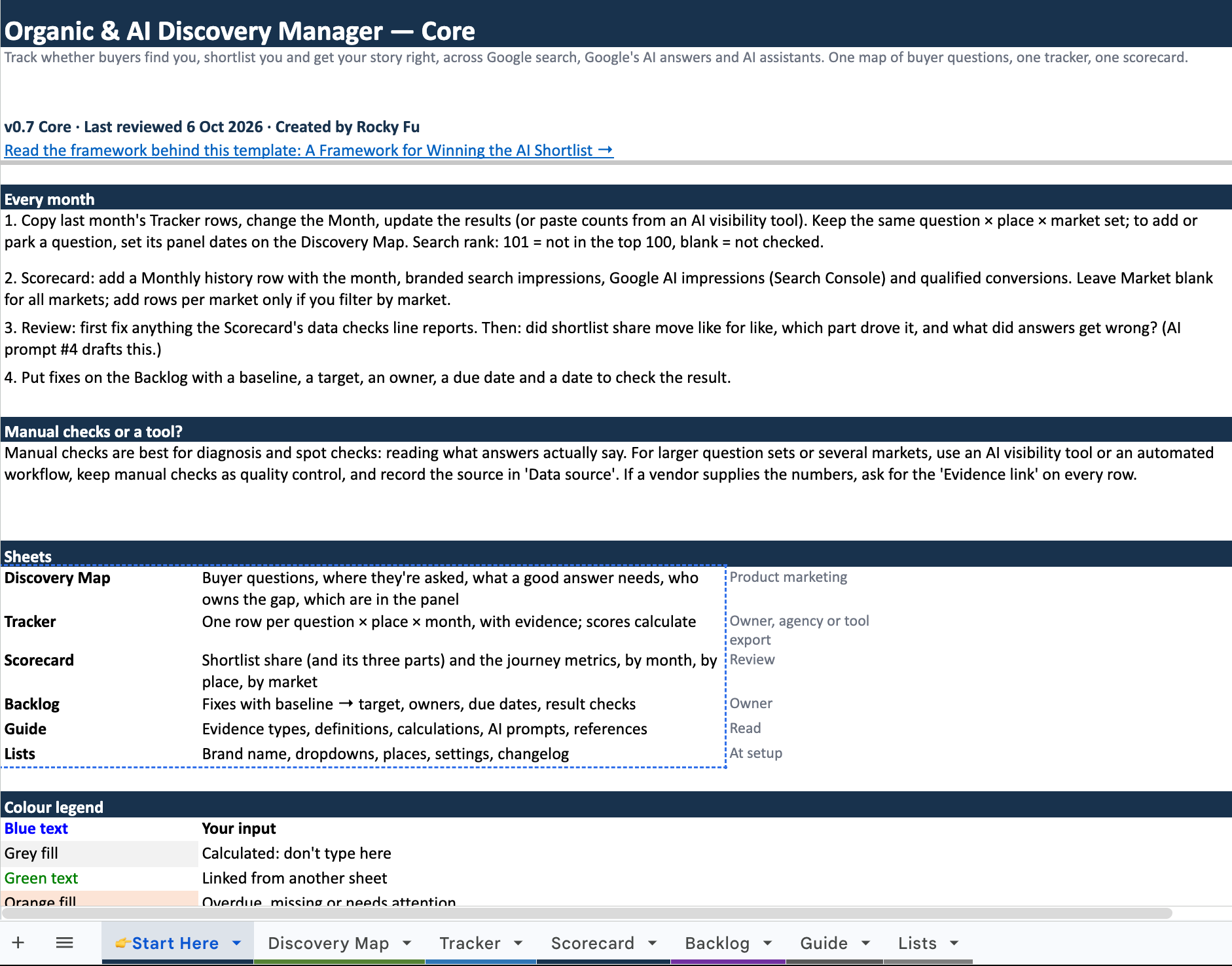
You start with a Discovery Map of your buyers’ real questions. Each month you check them in Google search, Google’s AI answers and AI assistants. The template then calculates shortlist share, split by channel, plus presence rate, answer accuracy and head-to-head win rate.
It flags results that rest on too little data and holds every fix to an owner and a date. The Core edition is all most teams need. The Full edition adds per-channel SEO, AEO and GEO scorecards, a KPI dictionary and an agency setup sheet. Subscribe for free and get the download link below.
References
OpenAI: DevDay 2026 recap (September 2026)
Google: Alphabet Q2 2026 earnings call, Sundar Pichai’s remarks (July 2026)
NBER: How People Use ChatGPT (September 2025)
G2: Half of B2B software buyers now start their research with AI chatbots (April 2026)
Semrush: AI search and SEO traffic study (July 2025)
Aggarwal et al.: GEO: Generative Engine Optimization (KDD 2024)
Think with Google: Decoding Decisions, making sense of the messy middle (2020)
Search Engine Land: The problem with AI share of voice and 3 metrics that matter more (June 2026)
OpenAI: ChatGPT ads expand to Southeast Asia and Taiwan (September 2026)
Google Search Console Help: Generative AI performance report
Search Engine Roundtable: Bing Webmaster Tools AI Performance adds grounding queries and pages views